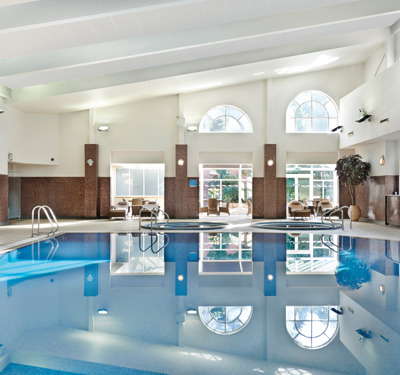
The Belfry is one of Britain’s defining Spa & Golf resorts: a substantial Midlands spa sits alongside three golf courses, led by the four-time Ryder Cup host Brabazon. It works particularly well for couples and groups because the golf has genuine pedigree while the spa offers enough pools, thermal experiences, treatments and relaxation space to be a destination in its own right.
Spa & golf card
Location: Wishaw, Sutton Coldfield, West Midlands B76 9PR
Best for: Golf-and-spa weekends, couples, groups, active breaks and Ryder Cup history
Spa highlights: Swimming pool, whirlpools, sauna, steam room, relaxation lounge and Fire & Ice bio-thermal experience
Treatments: Current treatment partners include ESPA and Dermalogica
Flagship golf: The Brabazon — par 72, 7,255 yards from the blue tees
Other courses: PGA National — par 72, 7,081 yards; The Derby — par 70, 6,099 yards
Practice: PGA National Academy with Toptracer range; TrackMan-supported coaching is also available
Brabazon heritage: Ryder Cup host in 1985, 1989, 1993 and 2002.
Why The Belfry works for Spa & Golf
The Belfry is unusually easy to understand as a mixed-interest break. Golfers have a choice of three courses, including one of the most recognisable tournament venues in Europe, while non-golfers do not have to make do with a small leisure club. The spa has a full thermal proposition, treatment spaces and relaxation areas, and the wider resort includes several restaurants and bars. That balance makes it practical for couples where only one person plays, as well as groups where some guests want a serious golf itinerary and others want a spa-led stay.
The Brabazon naturally receives most of the attention. Designed by Dave Thomas and Peter Alliss, it is a par-72 course measuring 7,255 yards from the blue tees and has hosted four Ryder Cups. Its history is woven into several holes: Seve Ballesteros famously drove the 10th green, while the closing stretch is associated with some of Europe’s most memorable Ryder Cup moments. For a first visit, playing the Brabazon gives the weekend a sense of occasion that a standard resort course cannot easily replicate.
The spa facilities
The Belfry’s current spa information lists a swimming pool, whirlpools, sauna, steam room and relaxation lounge. The pool gives guests the option of a proper swim rather than only passive hydrotherapy, while the whirlpools and heat facilities are well suited to a slower recovery session after golf. The relaxation lounge is useful before or after treatment, especially if one partner has finished a round earlier than the other.
The signature experience is Fire & Ice, a guided-style thermal journey through contrasting hot and cold environments. The current experience includes elements such as an aroma cave, foot baths, feature showers, steam and heated rooms, cooling spaces and hydrotherapy. It is designed as a sequence rather than a single sauna visit, so allow enough time for it rather than squeezing it between check-in and dinner.
Heat-and-cold experiences are not appropriate for everyone. The Belfry’s own booking information advises that Fire & Ice is not suitable during pregnancy, and the resort asks guests to consider medical suitability before participation. Anyone with cardiovascular conditions, recent surgery, significant injury or other relevant concerns should seek appropriate advice rather than assuming a thermal circuit is automatically suitable.
Treatments and recovery
The spa currently works with ESPA and Dermalogica across massage, facial and body-treatment options. For golfers, the most useful approach is often simple: do not book an unusually deep treatment immediately before an important round if you do not know how your body responds. Play first, rehydrate, eat properly and then choose recovery intensity based on how you actually feel.
On a two-round break, lighter pool and thermal time after the first round can be more useful than trying to fit a long treatment into an already busy day. A massage after the final round is easier to enjoy because temporary soreness or relaxation will not affect the next morning’s swing. Spa-day and spa-stay packages change seasonally, so confirm exactly what is included — treatment time, Fire & Ice access, dining and general spa access — rather than relying on an old package headline.
The three golf courses
The Brabazon is the bucket-list course: strategic bunkering, lakes, fast undulating greens and Ryder Cup history. PGA National provides a different challenge, with an inland-links character, a par of 72 and a published length of 7,081 yards. The Derby is shorter at 6,099 yards and par 70, making it a useful second-round option for golfers who want a less demanding follow-up or for mixed-ability groups.
The PGA National Academy’s Toptracer-equipped range makes pre-round preparation more useful than simply hitting a basket of balls without feedback. Coaching and TrackMan-supported analysis are available for players who want more structured help. For a short break, however, resist the temptation to turn every spare hour into practice: the strength of The Belfry is that golf, spa and social time can all sit within the same stay.
The Brabazon course card
Designer: Dave Thomas and Peter Alliss
Par: 72
Blue tees: 7,255 yards
White tees: 6,869 yards
Yellow tees: 6,449 yards
Red tees: 5,755 yards
Front nine: par 36
Back nine: par 36
Character: parkland championship golf with strategic bunkering, significant water hazards and large, often strongly contoured greens.
Hole-by-hole: Brabazon playing notes
- 1st — par 4: Do not let the opening tee shot become a statement of intent. Long hitters bring the right-side bunkers into play; a controlled drive finding grass leaves a far simpler approach to the large green.
- 2nd — par 4: Favour the right side of the fairway to open the angle into the green. This is one of the better early birdie chances if the tee shot is correctly positioned.
- 3rd — par 5: A drive down the left shortens the hole for players considering the green in two. If laying up, stop short of the lake and leave a full, committed approach; balls landing weakly at the front can feed back off the putting surface.
- 4th — par 4: Position the tee shot on the right half. The approach plays to a guarded, undulating green and can require an extra club, so trust the actual number rather than the visual impression.
- 5th — par 4: Lay back from the right-hand fairway bunker instead of automatically taking driver. The green is wide but shallow: short finds the guarding traps and long leaves an awkward recovery.
- 6th — par 4: The remodelled hole rewards a bold line up the left side, but only if you are striking it well. From position, the second shot attacks a heavily defended undulating green; otherwise accept the longer angle.
- 7th — par 3: Ignore a tempting flag at the edge and aim for the centre of the upturned-saucer green. Large bunkers collect misses and getting up and down is far from automatic.
- 8th — par 4: One of the toughest holes. Aim towards the right side of the fairway and remember the brook short of the green. Taking enough club for the approach is more important than chasing a heroic pin.
- 9th — par 4: The drive has to fit between trees and bunker. From the fairway, favour a shot finishing below the hole because the green falls towards the water and downhill putts can become defensive.
- 10th — par 4: The famous risk-reward hole. Only players with the required shape, carry and confidence should attempt the green from the tee: trees guard the right and water waits left. The percentage play is down the right, leaving a short wedge approach.
- 11th — par 4: The tee alignment can draw you towards trouble on the left. A controlled fade helps avoid bunkering on both sides; on the approach, take enough club to clear the front protection.
- 12th — par 3: Water runs along the right side and there is little reward for being timid. Commit to enough carry, while recognising that a shot finishing beyond the flag can leave a difficult putt back.
- 13th — par 4: The safer line is down the right. Out of bounds and a bunker protect the left; from the correct side, good distance control on the approach creates a realistic scoring opportunity.
- 14th — par 3: Sand surrounds the target. Favour a shot finishing short of the flag so the first putt is uphill rather than becoming aggressive towards a back position.
- 15th — par 5: The right side of the fairway can add useful run. Unless the green is clearly reachable in two, lay up short of the fairway bunker and leave a full shot into the long, three-tier putting surface.
- 16th — par 4: The approach is the key because relatively little of the green is visible from the fairway. Know the pin position before choosing a target; from a poor lie, play for the correct tier rather than forcing the flag.
- 17th — par 5: A committed drive over the dogleg can create a chance to reach in two. If the tee shot is out of position, lay up short of the brook and bunkers instead of compounding the error. The relatively flat green rewards a well-managed second or third shot.
- 18th — par 4: The aggressive left line shortens the approach but brings water heavily into play. The percentage route is towards the fairway bunker with a controlled shape. The three-tier green can demand several clubs’ difference depending on pin position, so the approach deserves more attention than the drive.
How to plan the weekend
For a first visit, make the Brabazon the centrepiece rather than trying to play all three courses in quick succession. A two-night stay works particularly well: arrive with time for Fire & Ice or a treatment, play the Brabazon on the full day, and use the final morning either for PGA National, The Derby or a slower recovery session. If one partner is not golfing, book spa treatment times early enough that the day feels deliberate rather than simply filling the hours while the golfer is away.
Golfers should arrive early enough to use the practice facilities and check current course conditions. The Brabazon’s strategy is based on positioning and green angles as much as raw length, so choosing the appropriate tee is more enjoyable than trying to reproduce professional tournament yardages. Weather and ground conditions can change how the water, run-outs and green complexes play, so use the hole notes as planning guidance rather than fixed instructions.
The Spa Traveller view
The Belfry remains one of the strongest UK answers to the dual-benefit weekend. Its golf history is authentic rather than manufactured, and the Brabazon gives players a genuine bucket-list round. Just as importantly, the spa has enough treatment, thermal and pool depth that a non-golfer can choose the resort for their own reasons. That balance — not merely putting a massage room beside a golf course — is what makes a Spa & Golf property genuinely useful.
Before you book
Golf course setup, tee availability, spa access, treatment brands, Fire & Ice arrangements and package inclusions can change. Brabazon yardages and hole strategy above are based on The Belfry’s current official course information and 2026 course guide checked in September 2026. Confirm current details directly with The Belfry before booking. The Spa Traveller provides independent editorial guidance and does not provide medical or professional golf instruction.