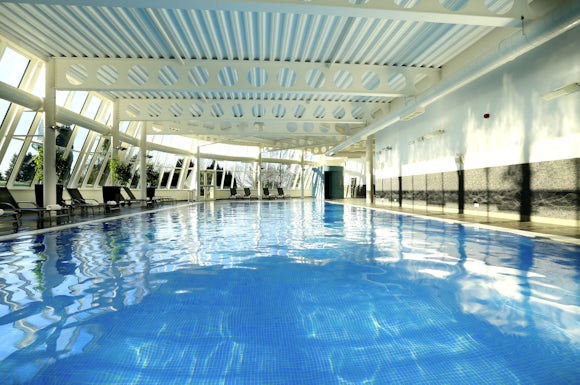
Macdonald Portal Hotel, Golf & Spa near Tarporley is one of Cheshire’s clearest Spa & Golf resorts, combining an 18-metre pool, thermal facilities and ELEMIS or ishga treatments with three golf courses. The Donald Steel-designed Championship Course is the flagship: a par-73 layout stretching to roughly 7,040 yards from the back, shaped by water, bunkering and several strategic risk-and-reward decisions. The shorter Premier and nine-hole Arderne add enough variety for a multi-round stay.
Spa & golf card
Location: Cobblers Cross Lane, Tarporley, Cheshire CW6 0DJ
Best for: Spa & Golf couples, Cheshire weekends, golf groups, active recovery and multi-round stays
Spa: ELEMIS and ishga treatments, relaxation room, spa lounge and Jennifer Young options where appropriate
Pool & thermal: 18-metre indoor pool, sauna, steam room and thermal facilities
Fitness: Life Fitness-equipped health club
Golf: Championship Course, Premier Course and nine-hole Arderne Course
Flagship guide: Championship — par 73, approximately 7,040 yards from the back markers
Premier: par 71, 6,538 yards on the hotel’s current description
Arderne: nine holes, par 30, approximately 1,724 yards
Current crossover package: Spa Escape & Play combines daily golf with a short ELEMIS or ishga treatment and spa/leisure access, subject to current package terms.
Why Portal works for Spa & Golf
Portal is built for the kind of mixed-interest break where both guests need a genuine reason to choose the same hotel. Golfers have three courses on site, including a championship layout with real strategic depth. Spa guests have a proper pool, thermal facilities, treatment rooms and relaxation space rather than a token leisure club. The resort’s current Spa Escape & Play package makes the pairing explicit by combining a round of golf with a treatment and full leisure access.
The three-course setup is especially useful for a two-night stay. The Championship is the obvious centrepiece, the Premier provides a full-length second round with a different character, and the Arderne gives a shorter nine-hole option when the group wants more time for spa or dining. That flexibility is more valuable than simply having one golf course beside a hotel.
The spa at Portal
The spa currently offers ELEMIS and ishga treatments across massage, facials and body therapies, with Jennifer Young options also listed within the wider Macdonald treatment framework. Treatment availability and suitability vary, so guests with pregnancy, recent surgery, cancer treatment or other medical considerations should discuss the appropriate option before booking rather than assuming every ritual is suitable.
The spa also includes a relaxation room and spa lounge, giving treatment guests somewhere quieter to sit before or after an appointment. This matters on a Spa & Golf weekend because the non-golfer can build an actual spa itinerary around treatment and leisure time instead of simply waiting in the main hotel.
Pool, thermal and fitness facilities
The health club centres on an 18-metre indoor swimming pool, with sauna, steam room and broader thermal facilities. The gym uses Life Fitness equipment and supports both cardiovascular and strength training. These facilities create a simple recovery option for golfers even when a full treatment is not part of the package.
For most players, a gentle swim, normal hydration and light mobility after a round are enough. Thermal facilities can be relaxing but should not be treated as a performance challenge. Guests with cardiovascular conditions, pregnancy, recent surgery or other relevant health concerns should check the suitability of heat and steam with an appropriate professional.
Treatments and golf recovery
Portal’s current Spa Escape & Play package is unusually well aligned with the Spa & Golf concept because it gives each day both a golf and spa element. The published format includes a short ELEMIS or ishga treatment, a round of golf, spa and leisure access, dining and accommodation. Package names, treatment duration and golf inclusions can change, so compare the live booking details rather than relying on an older headline.
If the golfer has an important round the following morning, keep any deeper massage conservative. Some players feel loose after bodywork; others feel temporarily tender. A longer or more intensive treatment is often more enjoyable after the final round, when there is no need to protect the next day’s swing.
Golf at Portal
The Championship Course is the resort’s flagship. Designed by Donald Steel, it opened in 1990 and was named Golf Course of the Year in 1995. Portal’s current site lists it at 7,041 yards in its headline data, while the descriptive body copy rounds the figure slightly differently. The Spa Traveller therefore treats it as an approximately 7,040-yard, par-73 championship layout rather than pretending a four-yard discrepancy is meaningful to the visitor.
The course is characterised by natural water, cascading features, strategic bunkering and several holes where the correct line from the tee matters more than maximum distance. The 3rd is a notable long par five at roughly 607 yards from the back, while the 14th is a distinctive par three with water in front and behind. The finishing hole climbs gently towards a strongly tiered green with a waterfall backdrop.
The Premier Course is listed at 6,538 yards and par 71 and provides a full second-round option. The Arderne Course is a nine-hole par-30 layout of approximately 1,724 yards, useful for beginners, a quick extra loop or mixed-ability groups.
Championship Course card
Designer: Donald Steel
Opened: 1990
Holes: 18
Par: 73
Back-tee length: approximately 7,040 yards
Style: Cheshire parkland with water, strategic bunkering and several elevated or risk-and-reward decisions
Longest early test: the 3rd, around 607 yards from the back markers
Signature par three: the 14th, with water influencing both front and rear of the green
Practice: golf shop and practice facilities on the wider resort.
Hole-by-hole: Championship Course playing notes
The hole names and strategy below are based on Macdonald Portal’s current official Championship Course guide, paraphrased into The Spa Traveller’s resort-golf format. Always use the day’s scorecard, tee markers, pin positions and weather.
- 1. Agincourt: The fairway is more welcoming than it first appears. Stronger players can consider carrying the visible bunkers, but there is no need to force the opening drive. A fairway ball leaves a far easier start than chasing distance into sand.
- 2. Arderne: One of the early scoring opportunities. The fairway contours can help gather a correctly positioned drive, so use the shape of the ground rather than fighting it. If the tee shot is strong, be positive with the approach and give yourself a realistic birdie chance.
- 3. Haddington’s Ground: The long par five is one of the defining early holes. The fairway moves around the dogleg and the elevated perspective can make distances deceptive. For most golfers, treat it as three controlled shots and lay up to a favourite number rather than forcing a heroic second.
- 4. Egerton’s Oaks: Another par five, but the line matters. A tee shot favouring the left opens the clearest route for the next shot. The hole rises significantly, so allow for elevation and accept that this is a genuine three-shot test for most players.
- 5. Townfield: The first par three is protected by a single major greenside bunker, but the deeper challenge is the long putting surface. Pin position can change the effective club substantially, so trust the measured yardage and target the correct section of green.
- 6. Lilley’s Gallop: An elevated tee creates a strong view of the hole, but a large tree divides the visual options. Longer hitters may be able to carry the tree; everyone else should choose a clear side and commit rather than steering indecisively around it.
- 7. Eaton Banks: The tee shot is partially blind and uses a marker to establish the intended line. Once over the brow, bunkers influence both sides and the fairway moves from right to left. Position is more valuable than maximum length, so choose a club you can place accurately.
- 8. Alvanley’s Gambol: A tactical dogleg where the fairway falls sharply away after the turning point. The tee shot needs precision because an over-aggressive line can run into a poor angle. Play to the correct side of the dogleg and let the approach become the scoring shot.
- 9. Marshall’s Leap: A classic risk-and-reward dogleg with out-of-bounds influencing the decision. Taking on more of the corner can leave a short pitch and a real birdie chance, but only if the required carry is comfortably within your normal game. Otherwise use the wider route.
- 10. Grisell’s Ride: A par five with birdie potential, but eight fairway bunkers create repeated decisions. A good drive can open the possibility of reaching or getting close in two, yet a planned three-shot strategy can be just as effective if it leaves a clean uphill approach.
- 11. The Temple: The drive must fit between bunkering and the boundary on the left. The fairway narrows into a bottleneck that can partially hide the approach, and the green sits high. Fairway position is critical; from the wrong angle, forcing the second is rarely worth it.
- 12. Royal Lodge: The fairway lies on a hillside, so stance and angle matter. The flatter approach position can be found towards the left, but the boundary sits close enough that over-correcting brings its own risk. Choose the line that leaves balance for the second shot.
- 13. Flaxyards: Undulating ground shapes both the drive and approach. The fairway becomes more generous beyond the initial bunkering, which can reward a confident tee shot. The greenside traps are deep, so the final approach needs enough carry rather than trying to run through the front.
- 14. The Horn: Portal’s signature par three. Water influences both the front and rear of the green, and the MacKenzie-style putting surface has meaningful contour and tiering. Club selection is everything: use the actual carry, identify the correct tier and make the centre of that section the target.
- 15. The River: The best chance of controlling the approach comes from getting the tee shot far enough down the fairway. A pond sits close to the target area, so the second requires an aerial shot with enough loft to stop. Do not try to manufacture a low running approach when the architecture asks for carry.
- 16. Henry’s Hollow: The final par three has a deceptive wind problem. Evergreen trees can shelter ground level while the wind above remains active, so the flag may not tell the whole story. Use the wider conditions, not just what you feel on the tee, when choosing the club.
- 17. Waterloo: One of the toughest late holes. Water influences both sides and fairway bunkers add pressure before an uphill approach. Keep the tee shot in play and accept that par is an excellent score; a conservative green target is far better than compounding a small error.
- 18. Done: A straightaway par four climbing gently towards the hotel side of the course. Bunkers shape the route and the final green has two pronounced tiers, with a waterfall creating a memorable backdrop. The key is leaving the approach on the correct tier so the final putt is manageable.
How to plan the stay
A two-night break gives Portal enough room to use all three sides of the resort. Use arrival day for spa or pool time, play the Championship on the full day and choose the Premier, Arderne or a final treatment the following morning. If the Spa Escape & Play package is available for your dates, compare its exact treatment and golf inclusions with booking the elements separately.
Golfers should confirm which course is attached to the package, especially if the Championship is the main reason for travel. Spa guests should book treatments early, because the resort’s crossover packages can create demand at the same times golfers are on the course. Families should also check current pool-access periods and spa age restrictions before arrival.
The Spa Traveller view
Portal is one of the more complete Cheshire Spa & Golf options because the resort has three genuine golf choices and enough spa infrastructure to keep the non-golfer engaged. The Championship has strategic character rather than simply length, and the official hole guide gives visitors a useful way to plan before arriving. Add the current Spa Escape & Play format and the hotel becomes a particularly practical dual-benefit weekend for couples who want different daytime activities without compromising the shared break.
Before you book
Spa access, treatment brands, golf-course setup, tee markers and package inclusions can change. The Championship Course is described by Portal at 7,041 yards in current headline information, while descriptive copy rounds the figure slightly differently; The Spa Traveller therefore uses approximately 7,040 yards rather than presenting false precision. Hole strategy above is based on the resort’s current official hole guide checked in September 2026. Confirm live details directly with Macdonald Portal before travel. The Spa Traveller provides independent editorial guidance and does not provide medical or professional golf instruction.