THE SPA TRAVELLER · PREMIUM SPA PROFILE
Discover the spa
Explore the treatments and practical details of The Spa at Carden Park. Check the latest availability, facilities and booking inclusions with the property.
Treatments
Ask the spa for its current treatment menu.
Facilities
Pool, thermal and relaxation facilities vary by property and package. Check the spa’s current facilities before booking.
Carden Park near Chester is one of the clearest Spa & Golf resorts in the North West, combining a stand-alone over-18s destination spa with two championship golf courses across a 1,000-acre Cheshire estate. The Spa at Carden is far more than a hotel leisure club, with a large outdoor Spa Garden, indoor thermal suite, vitality pools and dedicated relaxation spaces, while the Nicklaus Course provides a strategic 7,045-yard championship test supported by Toptracer and TrackMan practice facilities.
Spa & golf card
Location: Broxton Road, near Chester, Cheshire CH3 9DQ
Best for: Couples, Spa & Golf weekends, adult spa escapes, golf groups and mixed-interest short breaks
Spa policy: The Spa at Carden is a stand-alone facility with a strict over-18s policy
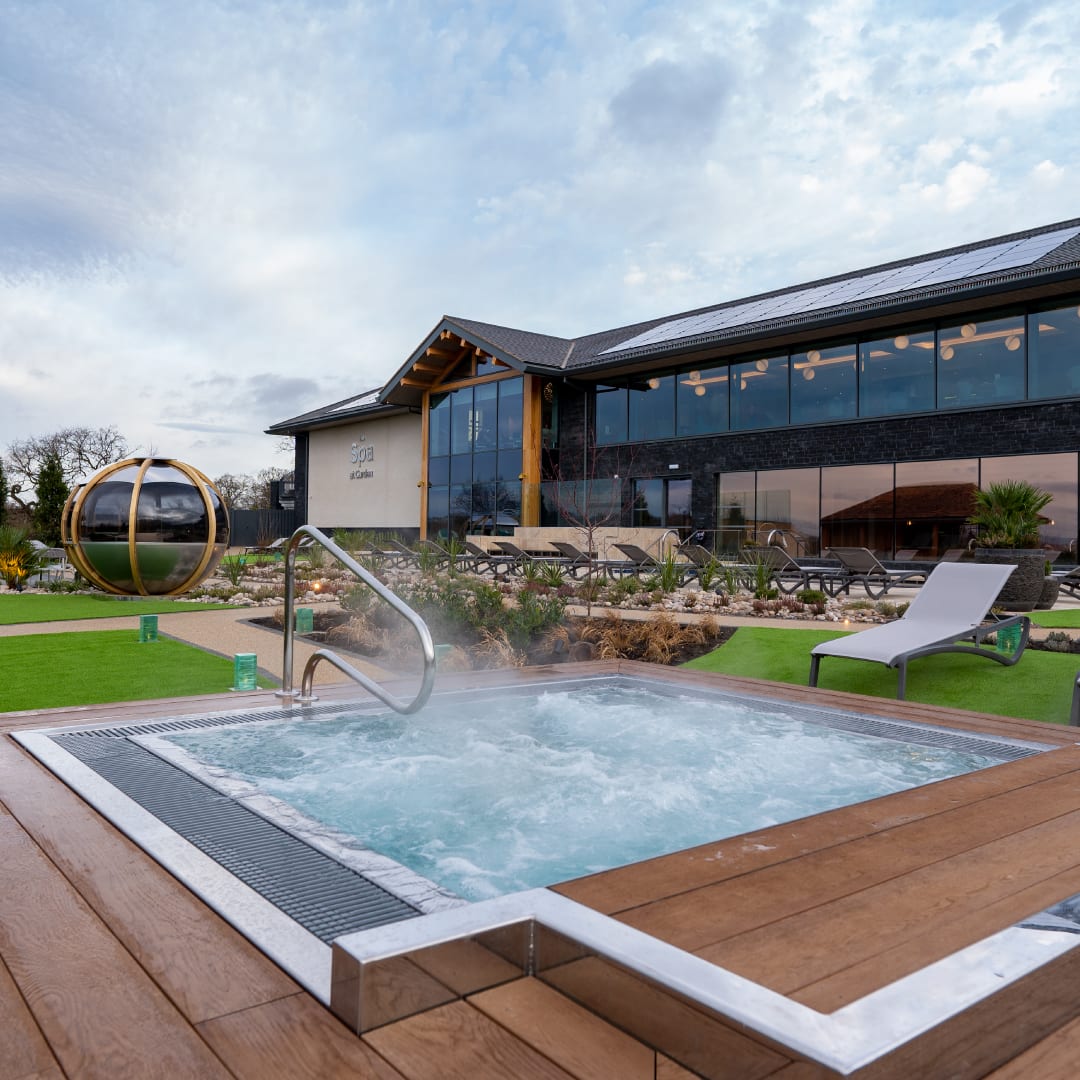
Spa Garden: Outdoor vitality pool, three hot tubs, panoramic herbal lounge, thermal pods, fire pit and garden bar
Thermal suite: Indoor vitality pool, heated relaxation beds, Finnish sauna, bio sauna, tepidarium, salt steam, aroma steam, experience showers and ice fountain
Relaxation: Panoramic, deep and sensory relaxation rooms for treatment guests
Golf: Nicklaus Course and Cheshire Course
Flagship guide: Nicklaus Course — par 72, 7,045 yards from the black markers
Practice: Toptracer driving range, short-game area, putting greens, PGA Academy and TrackMan custom fitting.
Why Carden Park works for Spa & Golf
Carden Park is unusually well suited to couples with different interests because the spa is deliberately separate from the main hotel leisure facilities. A non-golfer can book a serious adult-only spa experience rather than simply using the hotel pool while somebody else plays. At the same time, golfers have two full championship courses, a proper practice infrastructure and enough variety to build a multi-round stay.
The distinction between the destination spa and the hotel leisure club is important. Hotel guests receive access to the main leisure facilities, including a swimming pool, gym, sauna, jacuzzi and steam room, but access to the Spa at Carden is a separate experience unless specifically included in the package. Travellers should therefore check the confirmation carefully rather than assuming that an overnight hotel booking automatically includes the Spa Garden and thermal suite.
The Spa Garden
The outdoor Spa Garden is the feature that gives Carden its identity. The current facilities include a heated outdoor vitality pool, three hot tubs, panoramic herbal garden lounge, heated thermal pods, fire pit and an all-weather garden bar. It is designed for year-round use rather than simply as a summer terrace, which makes the resort particularly appealing for autumn and winter spa breaks.
Because the garden is large, it is easy to spend much of a half-day spa session outdoors without feeling that the experience depends on one pool or one hot tub. The thermal pods and lounge areas create quieter spaces between water experiences, while the fire pit and garden setting make the spa feel distinct from the main hotel.
Indoor thermal facilities
Inside, the thermal suite includes an indoor vitality pool, heated relaxation beds, Finnish sauna, bio sauna, tepidarium, salt steam room, aroma steam room, experience showers and an ice fountain. This range allows guests to build a gradual heat-and-cool sequence rather than moving directly between extreme temperatures.
As with all thermal experiences, more is not automatically better. Allow time to rest, drink water and leave a facility if you feel uncomfortable. Guests with cardiovascular conditions, pregnancy, recent surgery or other relevant health concerns should seek appropriate advice before using heat, cold or intensive treatment experiences.
Treatments and relaxation
Carden Park’s treatment experience is supported by three distinct relaxation rooms: panoramic, deep and sensory relaxation. Treatment guests can use these spaces before and after their ritual, which is particularly useful if the goal is to slow down rather than immediately return to a busy pool environment.
The spa also includes the Bollinger Beauty Bar for manicures, pedicures, facials, make-up and other beauty services. Carden’s planning guidance recommends arriving at least 30 minutes before an individual treatment. A treatment booking on its own includes access to the relaxation rooms but does not automatically include the Spa Garden and thermal facilities, so the package structure matters.
Golf and spa recovery
For golfers, the spa works best after rather than before the most important round. The Nicklaus Course is long enough and strategically demanding enough that arriving on the first tee after an unfamiliar deep treatment is unnecessary risk. A gentler approach is to use arrival day for the Spa Garden, play the flagship round the following day, and book a massage or longer ritual after the final round.
Carden’s wider hotel leisure club also provides a practical recovery option if the full destination spa is not included in the stay. A short swim, gentle mobility and normal hydration may be more useful between rounds than trying to fit a full half-day spa experience into an already busy schedule.
Golf at Carden Park
The estate has two championship courses. The Nicklaus Course, designed by Jack Nicklaus and Steve Nicklaus, is the more strategic modern layout, with water, bunkering and double-option fairways shaping several decisions. The Cheshire Course offers a different test, with more natural elevation changes, tree-lined sections and a dramatic finishing stretch.
The Nicklaus Course measures 7,045 yards from the black markers and 5,211 from the red markers. Carden Park describes the 7th and 15th as double-option holes where players must choose which fairway to use. An average fourball is advised to allow around four hours and 45 minutes, and the course can operate as a fourball layout in busy periods, meaning pairs may be matched with other golfers.
Practice facilities are strong. The Toptracer driving range has covered bays and is open to non-members, while the PGA Academy offers coaching. The custom-fitting studio uses TrackMan, and golfers can also use putting greens and a short-game area before play.
Nicklaus Course card
Design: Jack Nicklaus and Steve Nicklaus
Holes: 18
Par: 72
Black markers: 7,045 yards
Red markers: 5,211 yards
Style: Modern parkland/resort course with strategic water, bunkering and split-fairway decisions
Key decision holes: 6th, 7th and 15th
Practice: Toptracer range, short-game area, putting greens and TrackMan custom fitting
Pace: allow roughly 4¾ hours for an average fourball.
Hole-by-hole: Nicklaus Course playing notes
- 1st — par 4, SI 8: A substantial opening par four from the back markers. Position is more important than trying to overpower the first hole. Find the fairway, settle into the round and take the sensible section of green for the approach.
- 2nd — par 4, SI 18: The shortest and statistically friendliest par four on the outward nine. Treat it as a scoring opportunity by choosing a tee club that keeps the ball in play rather than turning a short hole into unnecessary recovery.
- 3rd — par 3, SI 16: At more than 200 yards from the back, this is not automatically easy despite its high stroke index. Use the actual yardage, favour centre-green and accept a long first putt over a short-sided miss.
- 4th — par 5, SI 6: Carden Park suggests this as a longest-drive hole, which signals space from the tee. Use that width, but only consider attacking the green in two when the lie and remaining distance genuinely justify it.
- 5th — par 4, SI 10: A mid-ranking par four where course management should stay simple: fairway first, then choose an approach target that keeps the strongest miss away from the short side.
- 6th — par 4, SI 12: This is the clearest early risk-reward decision. The lake can tempt longer hitters, but Carden’s own safe route is to play to the fairway on the right, leaving a short iron into a generous green. Unless you have the carry comfortably, take the percentage option.
- 7th — par 4, SI 2: One of the course’s signature split-fairway holes and one of its hardest by stroke index. Decide on the route before taking the club from the bag. The aggressive line can shorten the second shot; the conservative line prioritises position. Indecision is more dangerous than either clear plan.
- 8th — par 3, SI 14: A shorter par three than the 3rd. Use the opportunity to reset after the difficult 7th: take enough club for the middle of the target and avoid chasing a flag that does not suit your natural shot shape.
- 9th — par 5, SI 4: A strong closing hole to the outward nine. For most club golfers, a three-shot plan gives the best chance of par or bogey. Choose the second shot to leave a favourite wedge distance rather than merely advancing the ball as far as possible.
- 10th — par 4, SI 3: One of the harder par fours. Start the back nine with restraint: use the tee shot to secure a playable approach and accept that a centre-green target is a good result on a low-index hole.
- 11th — par 4, SI 5: Another demanding par four. Do not compound a mediocre drive by forcing the second. If the lie or angle is poor, play to the safest green entrance and let the short game protect the score.
- 12th — par 3, SI 13: The longest par three on the scorecard from the back markers. Take enough club and treat a safe part of the green as the target. Shortening the swing to “guide” a long iron is usually more dangerous than committing to the correct club.
- 13th — par 5, SI 7: A long par five that rewards a planned three-shot sequence. Unless the second shot is comfortably within range, position the lay-up to create a full third rather than leaving an awkward in-between distance.
- 14th — par 4, SI 15: Shorter on the card and a potential scoring hole, but the Nicklaus design uses water and bunkering to punish careless aggression. Choose a clear landing target from the tee and prioritise having a clean look at the green.
- 15th — par 4, SI 1: The hardest-ranked hole and a genuine strategic test. Out of bounds waits right, a ditch influences the left and the approach crosses a stream to an undulating protected green. The split-fairway choice matters: select the route that suits your normal shot rather than the one that looks most heroic.
- 16th — par 3, SI 17: Carden Park recommends this hole for nearest-the-pin competitions, and its shorter distance makes accuracy the priority. Use the centre of the green as the baseline target and only attack a flag when the club and wind make it comfortable.
- 17th — par 4, SI 11: The round comes back in front of the hotel, which adds visual pressure. Stay committed to the pre-shot routine rather than allowing the setting to speed you up. Position off the tee gives a far easier chance to control the approach.
- 18th — par 5, SI 9: A par-five finish creates opportunity as well as danger. Decide early whether the second is genuinely an attacking shot or a lay-up. A controlled third from a preferred yardage is usually a better way to finish than forcing a low-percentage long shot when tired.
How to plan the stay
For a two-night visit, use arrival day for the destination spa, play the Nicklaus on the full day and consider the Cheshire Course or a slower final spa session the following morning. Golfers who want to use the Toptracer range should allow extra time before the tee rather than adding a rushed practice session to the start of the round.
Non-golfing partners should book the Spa at Carden separately if it is not explicitly included in the hotel package. The stand-alone spa is often busy and has an over-18s policy, so it should be treated as a planned reservation rather than an amenity you can necessarily add on arrival.
The Spa Traveller view
Carden Park succeeds because the adult destination spa and the golf courses both have a clear identity. The Spa Garden can easily anchor a full non-golfing day, while the Nicklaus Course offers enough strategic interest for a serious player. For couples who want to spend part of the day apart and still feel they have chosen the same quality of experience, that is exactly what a strong Spa & Golf resort should provide.
Related guide
How to plan a Spa & Golf break
Use our practical guide to balance tee times, spa access, recovery, dining and shared time without turning the stay into competing schedules.
Before you book
Spa access, treatment availability, golf tee times, pairing arrangements and package inclusions can change. Nicklaus pars, stroke indexes and yardages above are based on Carden Park’s current official course information checked in September 2026. Hole strategy is deliberately conservative where detailed official hazard guidance is not published. Confirm live arrangements directly with Carden Park before booking. The Spa Traveller provides independent editorial guidance and does not provide medical or professional golf instruction.
Advertisement