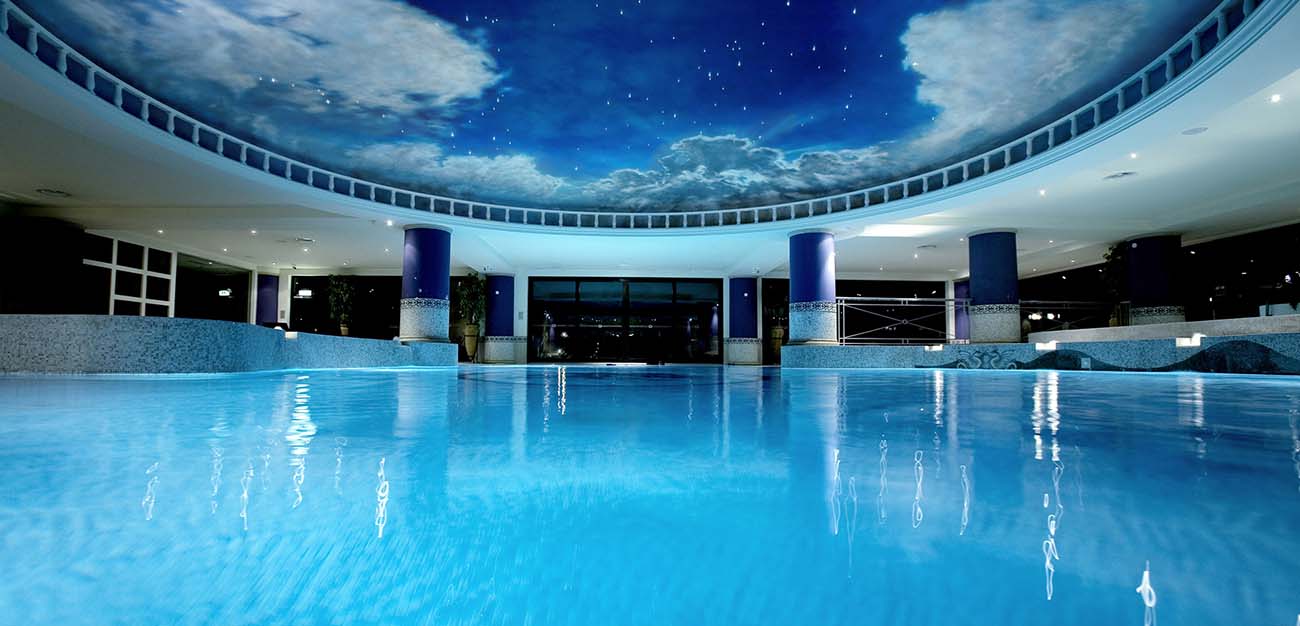
In the Usk Valley near Newport, Celtic Manor’s Forum Spa offers an ELEMIS-led collection of facial, body and massage treatments across 16 treatment rooms. The 20-metre indoor pool, spacious spa bath, sauna and steam facilities make this a compelling spa-day or wellness-break destination in its own right. Championship golf, dining and accommodation complement the spa experience elsewhere at the resort.
Explore the Gold Collection profile →
The Spa Traveller · Spa profile
Discover the Forum Spa
Set within Celtic Manor Resort in the Usk Valley, the Forum Spa is a substantial wellness destination for a treatment-led day or longer escape. The health club provides swimming, hydrotherapy and thermal facilities; check exactly what is included in your chosen spa-day or treatment package.
At a glance
Best for: Spa days, couples, friends and wellness breaks.
Signature experience: ELEMIS-led treatments and substantial pool and thermal facilities.
Setting: Usk Valley, South Wales.
Treatments
- ELEMIS facial treatments
- Massage therapies
- Body treatments
- Longer spa rituals (subject to current menu)
Confirm the latest treatment menu and availability with the spa.
Spa facilities
- 20-metre swimming pool
- Large freeform spa bath
- Sauna and steam facilities
- Changing-room spa baths
- 16 spa treatment rooms
- Technogym fitness environment
Facility access varies by booking package.
Spa & golf card
Location: Coldra Woods, The Usk Valley, Newport, South Wales NP18 1HQ
Best for: Spa & Golf couples, Ryder Cup fans, groups, active weekends and multi-night resort stays
Forum Spa: 16 treatment rooms with ELEMIS-led facial, body and massage treatments
Forum Health Club: 20-metre swimming pool, large freeform spa bath, sauna and steam facilities, changing-room spa baths and a substantial Technogym fitness environment
Golf: The Twenty Ten, Roman Road and Montgomerie championship courses
Flagship guide: The Twenty Ten — par 71, 7,493 yards from the back tees
Practice: Golf Academy, floodlit Toptracer range and TrackMan-supported tuition
Twenty Ten arrival: Celtic Manor recommends arriving around 60 minutes before the tee time to make use of the full pre-round experience.
Why Celtic Manor works for Spa & Golf
Celtic Manor is designed for mixed-interest resort stays. The golf side is serious enough for players to build an entire trip around it, yet the spa and leisure offer is large enough that a non-golfer is not simply waiting for the round to finish. That matters for couples and groups where priorities are different: one guest can spend much of the day on the Twenty Ten while another uses the Forum Spa, Health Club and wider resort facilities, and both still share dining and accommodation afterwards.
The golf has real event history. The Twenty Ten was created specifically to host the 2010 Ryder Cup, while Roman Road and the Montgomerie give repeat visitors alternative styles and a less ceremonial second round. For the spa guest, the Forum is not a token massage room attached to a golf hotel. Sixteen treatment rooms, a 20-metre pool and substantial hydrothermal facilities make it credible as a destination within the resort.
Advertisement
Forum Spa
The Forum Spa currently lists 16 treatment rooms and uses ELEMIS products across facial, body and sensory treatments. Massage, skincare and longer treatment rituals can be booked independently, while the resort also sells spa-day and overnight packages that bundle treatment time with health-club access and, in some cases, food or accommodation.
A key booking detail is that a treatment on its own does not automatically include use of the Forum Health Club. That distinction is easy to miss when comparing packages. If pool, sauna, steam or spa-bath access is important, check the exact inclusion before paying rather than assuming that every treatment booking grants full facility access.
Forum Health Club facilities
Hotel guests receive access to the Forum Health Club, subject to the resort’s current session and booking arrangements. The core facilities include a 20-metre swimming pool and a very large freeform spa bath. The changing rooms have additional spa baths, sauna and steam facilities, while the gym uses modern Technogym equipment and supports both conventional fitness and more sport-specific training.
The health club is particularly useful for golfers because it allows recovery to be simple rather than over-engineered. A gentle swim, easy mobility session and time in the steam room may be enough after a round. There is no need to turn recovery into another competition. Hydration, food and sleep still matter more than trying to compensate for fatigue with an aggressive thermal circuit or deep massage.
The resort operates age restrictions for sauna, steam and spa-pool use, currently requiring users to be 16 or over for those facilities. Anyone with cardiovascular conditions, pregnancy, recent surgery, injury or another relevant health concern should discuss the suitability of heat, hydrotherapy and intensive treatments with an appropriate professional before use.
Treatments and golfer recovery
ELEMIS-led massage and body treatments give golfers a straightforward route into spa recovery. The safest timing is usually after golf rather than immediately before a significant round, particularly if the treatment is deeper or unfamiliar. Some golfers feel loose after massage; others feel temporarily heavy or tender. If the next morning’s score matters, do not experiment the night before.
For a two-round stay, keep the first recovery session light: swim, move gently, eat and rehydrate. After the final round, there is more freedom to book a longer massage or body treatment because you no longer need to protect the next day’s swing. Non-golfing partners should book spa time early, especially at weekends, so the day feels like a planned experience rather than a way to fill the hours while somebody else is on the course.
Golf at Celtic Manor
The resort has three full courses. The Twenty Ten is the Ryder Cup layout and measures 7,493 yards from the back tees at par 71. It was designed in two stages by Robert Trent Jones Jr and Ross McMurray, with a mixture of open, links-like early holes, lake-lined middle sections and a demanding closing stretch. Water hazards influence roughly half the course.
Roman Road is a Robert Trent Jones Sr parkland course with its own professional-tournament history. The Montgomerie, designed by Colin Montgomerie, adds more elevation change, pot bunkering and strong Usk Valley views. For a first visit, however, the Twenty Ten should be the strategic focus because the clubhouse, practice experience and Ryder Cup history make it distinct from a normal resort round.
Twenty Ten course facts — tap to expand
Par: 71
Back-tee length: 7,493 yards
Architectural lineage: Robert Trent Jones Jr and Ross McMurray
Opened in its Ryder Cup form: built specifically to stage the 2010 Ryder Cup
Style: modern championship parkland with links-like opening character, substantial lakes and stadium-style risk-and-reward holes
Water: comes into play on around half the holes
Clubhouse: Twenty Ten Clubhouse overlooking the 18th, with locker rooms, bar/restaurant and pro-shop facilities
Pre-round: practice facilities and warm-up access are part of the Twenty Ten experience; allow time rather than arriving at the first tee at the last minute.
Twenty Ten hole-by-hole playing notes — tap to expand
- 1st — par 4: The dogleg-left opener rewards a drive that challenges the left-side bunkers, but there is no need to force the issue. A fairway ball is far more valuable than a heroic angle from sand; the green is well protected and run-off areas punish an indifferent approach.
- 2nd — par 5: Long and narrow. Keep the tee shot straight and treat the hole as a disciplined three-shot par five unless the second is genuinely comfortable. Steep run-offs around the green can turn a slightly missed attacking shot into a difficult recovery.
- 3rd — par 3: Water guards the front and left, with sand on the opposite side. Club selection is more important than pin-chasing: take enough club to carry the hazard but avoid becoming so aggressive that you bring the difficult long recovery into play.
- 4th — par 4: This strong par four can play longer than it appears when the wind is against you. The green has plenty of contour, so a solid fairway drive and conservative distance control on the second shot are more useful than chasing a tucked flag.
- 5th — par 4: Finding the fairway is critical because the approach crosses a stream and needs precise control. Short can feed back towards water, while long leaves an awkward recovery. Treat the middle of the green as a good target unless the flag position is genuinely inviting.
- 6th — par 4: Water runs down the right from tee to green. The aggressive line can leave a short iron, but the percentage play is centre-left with enough club left for the approach. Choose the risk level before you swing rather than changing strategy halfway through the shot.
- 7th — par 3: A long par three to a relatively small target. In wind, it may require far more club than expected. Missing slightly right can be preferable to tangling with the heavier rough left, but the principal goal is simply enough carry to find the putting surface.
- 8th — par 4: The tee shot is visually tighter than it first appears, with bunkering on both sides. Favour the left half of the fairway. The green falls strongly from right to left, and a miss on the right leaves one of the harder short-game recoveries on the course.
- 9th — par 5: A very long par five with out-of-bounds and the Usk side influencing the left and bunkering shaping the right. Most club golfers should plan it as three shots: position the drive, lay up to a comfortable wedge yardage and avoid turning length into unnecessary risk.
- 10th — par 3: The green slopes from the back and from right to left, and swirling wind can complicate club selection. Aim for the correct section of green rather than merely the flag; a well-positioned first putt is often the real scoring advantage.
- 11th — par 5: Downhill and potentially attackable after a strong drive, but water left and a bunker right shape the decision. If the tee shot is not in ideal position, lay up rather than forcing the second. The green is defended by bunkers and a pronounced swale to the left.
- 12th — par 4: One of the clearest water tests. The approach plays uphill across a lake, so under-clubbing is the obvious mistake. Take enough club to clear the hazard and accept the middle of the green; a cautious swing with insufficient carry is more dangerous than a committed conservative target.
- 13th — par 3: Another lake carry. A flag on the right can tempt you towards the water, while bunkering also waits left-rear. The sensible play is to choose a target that guarantees the carry and gives yourself a putt rather than trying to manufacture a perfect line.
- 14th — par 4: The classic risk-and-reward hole. Water influences the tee shot on the right and then flips sides for the approach, while bunkering defends the alternative line. Play left from the tee if you want the conservative route; only challenge the aggressive water line if the carry and shape are well within your normal game.
- 15th — par 4: A short match-play-style hole where longer hitters can consider the direct route. The aggressive line brings stream, mounding and heavy rough into play; the safer route leaves a more conventional approach. Choose one strategy and commit rather than steering between the two.
- 16th — par 4: Long and demanding. Carry the left-side bunkering from the tee if your chosen line requires it, then favour the left side on the approach because the green slopes significantly from left to right and can feed a well-planned shot towards the target.
- 17th — par 3: A long par three to an elongated, two-level green. Distance control matters more than flag-hunting: being on the wrong tier can create a very difficult putt, while a miss right leaves a demanding recovery.
- 18th — par 5: A memorable finish with the green protected by water and bunkering. A strong drive can create a chance to reach in two, but a lay-up must be planned carefully because the third can spin back towards the water. Leave a yardage from which you can control trajectory and spin rather than laying up blindly.
How to plan the stay
For a first Celtic Manor visit, a two-night structure works best. Use arrival day for Forum Spa or Health Club time, play the Twenty Ten on the full day, and use the final morning for either Roman Road, the Montgomerie or a slower recovery session. This avoids trying to cram golf, treatments, swimming and dinner into one rushed day.
Golfers should arrive early enough to enjoy the Twenty Ten warm-up and clubhouse experience. Celtic Manor’s current golf information encourages players to arrive about an hour before their tee time, which makes sense: the Ryder Cup locker-room setting and practice facilities are part of the appeal. If travelling as a mixed group, coordinate tee times with spa bookings so nobody has to abandon a treatment or rush back from the course to make dinner.
The Spa Traveller view
Celtic Manor is one of the UK’s clearest examples of a true Spa & Golf resort because neither proposition is incidental. The Twenty Ten provides genuine Ryder Cup theatre and a strategically demanding round; the Forum Spa and Health Club provide enough treatment, swimming and thermal depth for a full non-golfing day. For couples and groups seeking a shared luxury base with different daytime interests, that combination is exactly what the Spa & Golf category should deliver.
Related guide
How to plan a Spa & Golf break
Use our practical guide to balance tee times, spa access, recovery, dining and shared time without turning the stay into competing schedules.
Before you book
Spa access, treatment availability, health-club session rules, golf course setup and package inclusions can change. Twenty Ten strategy above is based on current Celtic Manor course information together with established tournament-course guidance checked in September 2026. Confirm live arrangements directly with Celtic Manor before booking. The Spa Traveller provides independent editorial guidance and does not provide medical or professional golf instruction.

The Spa Traveller Awards Winner
Historic award recognition
This spa appears in The Spa Traveller’s historic Awards archive in the following categories:
- Best Day Spa—Wales
- Best for a Spa Day—Wales
- Best UK Family-Friendly Spa Resort
- Best UK Hotel Spa—more than 50 rooms
- Best UK Spa for Groups
This records recognition from an earlier Awards period and should not be read as a current award or unchanged endorsement.
Treatment brand
ELEMIS
ELEMIS is part of the treatment-brand context for this resort spa. Explore the brand alongside the wider facilities and Spa & Golf experience.
Plan & book
Book Celtic Manor directly
Check current spa days, spa breaks, treatments and live availability with Celtic Manor Resort.
View Celtic Manor spa days & breaks →
Booking is completed directly with Celtic Manor Resort under its own terms and availability. The Spa Traveller does not take payment or combine travel services.